
- Bible
- Read the Bible
- Bible Versions
- Verse of the Day
- Reading Plans
- Verses by Topic
- Books of the Bible
- Bible Images
- Study
- Commentaries
- Concordances
- Dictionaries
- Encyclopedias
- Sermons
- Bible Atlas & Maps
- BP Wiki
- Devotionals
- Today's Devotionals
- Light of the World
- All Devotionals
- Inspirational Quotes
- More
- Picture Quotes
- Videos
- Inspirational
- Bible Study
- What The Bible Says
- Bible Q&As
- Daily Bread
- Bible by Genre
- Bible Stories
- Random Bible Verse
- Community
- Store
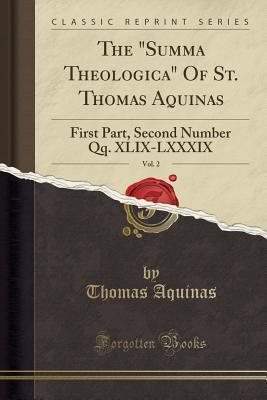
Excerpt from The "Summa Theologica" Of St. Thomas Aquinas: Part II. (First Part); Literally Translated by Fathers of the English Dominican Province; Second Number (Qq; XLIX-LXXXIX)
After treating of human acts and passions, we now pass on to the consideration of the principles of human acts, and firstly of intrinsic principles, secondly of extrinsic principles. The intrinsic principle is the power and the habit; but as we have treated of the powers in the First Part, it remains for us to consider the habits. And in the first place we shall consider them in general: in the second place we shall con sider virtues and Vices and other like habits, which are the principles of human acts.
Concerning habits in general there are four questions to be considered: Firstly, the substance of habits; secondly, their subject; thirdly, the cause of their generation, increase, and corruption; fourthly, how they are distinguished from one another.
Under the first head, there are four points of inquiry: (i) Whether habit is a quality (2) Whether it is a distinct species of quality (3) Whether habit implies an order to an act (4) Of the necessity of habit.
About the Publisher
Forgotten Books publishes hundreds of thousands of rare and classic books. Find more at www.forgottenbooks.comwww.forgottenbooks.com
This book is a reproduction of an important historical work. Forgotten Books uses state-of-the-art technology to digitally reconstruct the work, preserving the original format whilst repairing imperfections present in the aged copy. In rare cases, an imperfection in the original, such as a blemish or missing page, may be replicated in our edition. We do, however, repair the vast majority of imperfections successfully; any imperfections that remain are intentionally left to preserve the state of such historical works.
After treating of human acts and passions, we now pass on to the consideration of the principles of human acts, and firstly of intrinsic principles, secondly of extrinsic principles. The intrinsic principle is the power and the habit; but as we have treated of the powers in the First Part, it remains for us to consider the habits. And in the first place we shall consider them in general: in the second place we shall con sider virtues and Vices and other like habits, which are the principles of human acts.
Concerning habits in general there are four questions to be considered: Firstly, the substance of habits; secondly, their subject; thirdly, the cause of their generation, increase, and corruption; fourthly, how they are distinguished from one another.
Under the first head, there are four points of inquiry: (i) Whether habit is a quality (2) Whether it is a distinct species of quality (3) Whether habit implies an order to an act (4) Of the necessity of habit.
About the Publisher
Forgotten Books publishes hundreds of thousands of rare and classic books. Find more at www.forgottenbooks.comwww.forgottenbooks.com
This book is a reproduction of an important historical work. Forgotten Books uses state-of-the-art technology to digitally reconstruct the work, preserving the original format whilst repairing imperfections present in the aged copy. In rare cases, an imperfection in the original, such as a blemish or missing page, may be replicated in our edition. We do, however, repair the vast majority of imperfections successfully; any imperfections that remain are intentionally left to preserve the state of such historical works.
BUY NOW
Paperback, 520 pages
Published August 13th 2016 by Forgotten Books
Subscribe
Get Bible verse every day in your inbox
Read on Mobile


Group of Brands


© 2026 Bibleportal.com All rights reserved.
Thomas Aquinas was an immensely influential philosopher and theologian in the tradition of scholasticism, known as Doctor Angelicus and Doctor Communis.
He was the foremost classical proponent of natural theology, and the father of the Thomistic school of philosophy and theology. His influence on Western thought is considerable, and much of modern philosophy was conceived as a reaction against, or as an agreement with, his ideas, particularly in the areas of ethics, natural law and political theory.
The philosophy of Aquinas has exerted enormous influence on subsequent Christian theology, especially that of the Roman Catholic Church, extending to Western philosophy in general, where he stands as a vehicle and modifier of Aristotelianism, which he fused with the thought of Augustine.
... Show more