
- Bible
- Read the Bible
- Bible Versions
- Verse of the Day
- Reading Plans
- Verses by Topic
- Books of the Bible
- Bible Images
- Study
- Commentaries
- Concordances
- Dictionaries
- Encyclopedias
- Sermons
- Bible Atlas & Maps
- BP Wiki
- Devotionals
- Today's Devotionals
- Light of the World
- All Devotionals
- Inspirational Quotes
- More
- Picture Quotes
- Videos
- Inspirational
- Bible Study
- What The Bible Says
- Bible Q&As
- Daily Bread
- Bible by Genre
- Bible Stories
- Random Bible Verse
- Community
- Store
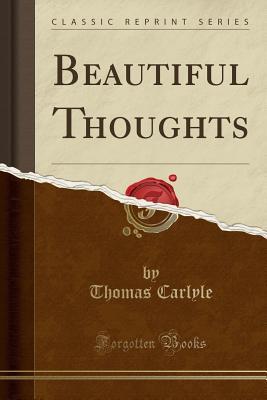
Beautiful Thoughts (Classic Reprint)
by Thomas Carlyle
Excerpt from Beautiful Thoughts
All that was strong claimed his homage. Shams and subterfuges were the butt of his sarcasm because they were the symbols of weakness. The really strong man disdained all lies because he was powerful enough to be truthful, even if truth was brutal in its expression. It is in his delineation of the forces and pas sions that move great men and great masses of people that Carlyle compels our admiration, and has added to our literature an abundance of Beautiful Thoughts. Thoughts that are Beauti ful, not by reason of their elegance of diction or of expression, but Beautiful in their strength and ruggedness, having the beauty not of the flower but of the grey granite that towers above the pretty verdure at its feet.
About the Publisher
Forgotten Books publishes hundreds of thousands of rare and classic books. Find more at www.forgottenbooks.comwww.forgottenbooks.com
This book is a reproduction of an important historical work. Forgotten Books uses state-of-the-art technology to digitally reconstruct the work, preserving the original format whilst repairing imperfections present in the aged copy. In rare cases, an imperfection in the original, such as a blemish or missing page, may be replicated in our edition. We do, however, repair the vast majority of imperfections successfully; any imperfections that remain are intentionally left to preserve the state of such historical works.
All that was strong claimed his homage. Shams and subterfuges were the butt of his sarcasm because they were the symbols of weakness. The really strong man disdained all lies because he was powerful enough to be truthful, even if truth was brutal in its expression. It is in his delineation of the forces and pas sions that move great men and great masses of people that Carlyle compels our admiration, and has added to our literature an abundance of Beautiful Thoughts. Thoughts that are Beauti ful, not by reason of their elegance of diction or of expression, but Beautiful in their strength and ruggedness, having the beauty not of the flower but of the grey granite that towers above the pretty verdure at its feet.
About the Publisher
Forgotten Books publishes hundreds of thousands of rare and classic books. Find more at www.forgottenbooks.comwww.forgottenbooks.com
This book is a reproduction of an important historical work. Forgotten Books uses state-of-the-art technology to digitally reconstruct the work, preserving the original format whilst repairing imperfections present in the aged copy. In rare cases, an imperfection in the original, such as a blemish or missing page, may be replicated in our edition. We do, however, repair the vast majority of imperfections successfully; any imperfections that remain are intentionally left to preserve the state of such historical works.
BUY NOW
Paperback, 332 pages
Published April 25th 2018 by Forgotten Books
Subscribe
Get Bible verse every day in your inbox
Read on Mobile


Group of Brands


© 2026 Bibleportal.com All rights reserved.
Thomas Carlyle was a Scottish satirical writer, essayist, historian and teacher during the Victorian era. He called economics "the dismal science", wrote articles for the Edinburgh Encyclopedia, and became a controversial social commentator.
Coming from a strict Calvinist family, Carlyle was expected by his parents to become a preacher, but while at the University of Edinburgh, he lost his Christian faith. Calvinist values, however, remained with him throughout his life. This combination of a religious temperament with loss of faith in traditional Christianity made Carlyle's work appealing to many Victorians who were grappling with scientific and political changes that threatened the traditional social order.
... Show more