
- Bible
- Read the Bible
- Bible Versions
- Verse of the Day
- Reading Plans
- Verses by Topic
- Books of the Bible
- Bible Images
- Study
- Commentaries
- Concordances
- Dictionaries
- Encyclopedias
- Sermons
- Bible Atlas & Maps
- BP Wiki
- Devotionals
- Today's Devotionals
- Light of the World
- All Devotionals
- Inspirational Quotes
- More
- Picture Quotes
- Videos
- Inspirational
- Bible Study
- What The Bible Says
- Bible Q&As
- Daily Bread
- Bible by Genre
- Bible Stories
- Random Bible Verse
- Community
- Store
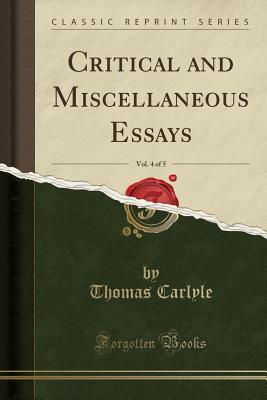
Critical and Miscellaneous Essays, Vol. 4 of 5 (Classic Reprint)
by Thomas Carlyle
Excerpt from Critical and Miscellaneous Essays, Vol. 4 of 5
Another remark, on a lower scale, not unworthy of notice, is by Jean Paul: that as in art, so in conduct, or what we call morals, before there can be an Aristotle with his critical canons, there must be 9. Homer, many Homers with their heroic performances. In plainer words, the original man is the true creator (or call him revealer) of Morals too: it is from his example that precepts enough are derived, and written down in books and systems: he properly is the thiazg; all that follows after is but talk about the thing, better or worse interpretation of it, more or less wearisome and ineffectual discourse of logic on it. A remark this Of Jean Paul's which, ' well meditated, may seem one of the most pregnant late written on these matters. If any man had the ambition of building a new system of morals (not a promising enterprise.
About the Publisher
Forgotten Books publishes hundreds of thousands of rare and classic books. Find more at www.forgottenbooks.comwww.forgottenbooks.com
This book is a reproduction of an important historical work. Forgotten Books uses state-of-the-art technology to digitally reconstruct the work, preserving the original format whilst repairing imperfections present in the aged copy. In rare cases, an imperfection in the original, such as a blemish or missing page, may be replicated in our edition. We do, however, repair the vast majority of imperfections successfully; any imperfections that remain are intentionally left to preserve the state of such historical works.
Another remark, on a lower scale, not unworthy of notice, is by Jean Paul: that as in art, so in conduct, or what we call morals, before there can be an Aristotle with his critical canons, there must be 9. Homer, many Homers with their heroic performances. In plainer words, the original man is the true creator (or call him revealer) of Morals too: it is from his example that precepts enough are derived, and written down in books and systems: he properly is the thiazg; all that follows after is but talk about the thing, better or worse interpretation of it, more or less wearisome and ineffectual discourse of logic on it. A remark this Of Jean Paul's which, ' well meditated, may seem one of the most pregnant late written on these matters. If any man had the ambition of building a new system of morals (not a promising enterprise.
About the Publisher
Forgotten Books publishes hundreds of thousands of rare and classic books. Find more at www.forgottenbooks.comwww.forgottenbooks.com
This book is a reproduction of an important historical work. Forgotten Books uses state-of-the-art technology to digitally reconstruct the work, preserving the original format whilst repairing imperfections present in the aged copy. In rare cases, an imperfection in the original, such as a blemish or missing page, may be replicated in our edition. We do, however, repair the vast majority of imperfections successfully; any imperfections that remain are intentionally left to preserve the state of such historical works.
BUY NOW
Paperback, 642 pages
Published January 12th 2019 by Forgotten Books
Subscribe
Get Bible verse every day in your inbox
Read on Mobile


Group of Brands


© 2026 Bibleportal.com All rights reserved.
Thomas Carlyle was a Scottish satirical writer, essayist, historian and teacher during the Victorian era. He called economics "the dismal science", wrote articles for the Edinburgh Encyclopedia, and became a controversial social commentator.
Coming from a strict Calvinist family, Carlyle was expected by his parents to become a preacher, but while at the University of Edinburgh, he lost his Christian faith. Calvinist values, however, remained with him throughout his life. This combination of a religious temperament with loss of faith in traditional Christianity made Carlyle's work appealing to many Victorians who were grappling with scientific and political changes that threatened the traditional social order.
... Show more