
- Bible
- Read the Bible
- Bible Versions
- Verse of the Day
- Reading Plans
- Verses by Topic
- Books of the Bible
- Bible Images
- Study
- Commentaries
- Concordances
- Dictionaries
- Encyclopedias
- Sermons
- Bible Atlas & Maps
- BP Wiki
- Devotionals
- Today's Devotionals
- Light of the World
- All Devotionals
- Inspirational Quotes
- More
- Picture Quotes
- Videos
- Inspirational
- Bible Study
- What The Bible Says
- Bible Q&As
- Daily Bread
- Bible by Genre
- Bible Stories
- Random Bible Verse
- Community
- Store
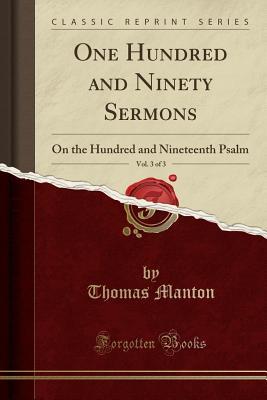
One Hundred and Ninety Sermons, Vol. 3 of 3: On the Hundred and Nineteenth Psalm (Classic Reprint)
by Thomas Manton
Excerpt from One Hundred and Ninety Sermons, Vol. 3 of 3: On the Hundred and Nineteenth Psalm
Verse 124. - Deal with thy servant according to thy mercy and teach me thy statutes.
In this verse, we have two requests, the one general, the other partien lar; wherein he would have the Lord exercise his mercy to him, Show thy mercy to me, in teaching me thy law.' The one respects the privilege part of religion, the other the duty part. The one concerns time past, or the pardon of sin already committed, Deal with thy servant according to thy mercy; the other, prevention of sin for the time to come, That I may perform my duty for the future, teach me thy statutes. Mercy is the ground of his request; teaching God's law, the matter of it. He would have this gift bestowed on him freely.
About the Publisher
Forgotten Books publishes hundreds of thousands of rare and classic books. Find more at www.forgottenbooks.comwww.forgottenbooks.com
This book is a reproduction of an important historical work. Forgotten Books uses state-of-the-art technology to digitally reconstruct the work, preserving the original format whilst repairing imperfections present in the aged copy. In rare cases, an imperfection in the original, such as a blemish or missing page, may be replicated in our edition. We do, however, repair the vast majority of imperfections successfully; any imperfections that remain are intentionally left to preserve the state of such historical works.
Verse 124. - Deal with thy servant according to thy mercy and teach me thy statutes.
In this verse, we have two requests, the one general, the other partien lar; wherein he would have the Lord exercise his mercy to him, Show thy mercy to me, in teaching me thy law.' The one respects the privilege part of religion, the other the duty part. The one concerns time past, or the pardon of sin already committed, Deal with thy servant according to thy mercy; the other, prevention of sin for the time to come, That I may perform my duty for the future, teach me thy statutes. Mercy is the ground of his request; teaching God's law, the matter of it. He would have this gift bestowed on him freely.
About the Publisher
Forgotten Books publishes hundreds of thousands of rare and classic books. Find more at www.forgottenbooks.comwww.forgottenbooks.com
This book is a reproduction of an important historical work. Forgotten Books uses state-of-the-art technology to digitally reconstruct the work, preserving the original format whilst repairing imperfections present in the aged copy. In rare cases, an imperfection in the original, such as a blemish or missing page, may be replicated in our edition. We do, however, repair the vast majority of imperfections successfully; any imperfections that remain are intentionally left to preserve the state of such historical works.
BUY NOW
Paperback, 548 pages
Published July 31st 2018 by Forgotten Books (first published September 12th 2013)
Subscribe
Get Bible verse every day in your inbox
Read on Mobile


Group of Brands


© 2026 Bibleportal.com All rights reserved.
Thomas Manton was an English Puritan clergyman.
Born at Lydeard St Lawrence, Somerset, Manton was educated at Blundell's School and then at Hart Hall, Oxford where he graduated BA in 1639. Joseph Hall, bishop of Norwich, ordained him deacon the following year: he never took priest's orders, holding that he was properly ordained to the ministerial office. He was then appointed town lecturer of Collumpton in Devon. In the winter of 1644-1645, he was appointed to preach at St Mary's Church in the parish of Stoke Newington in Middlesex, where in 1646 he was joined by Alexander Popham as the parish's ruling elder and began to build a reputation as a forthright and popular defender of Reformed principles.
Although Manton is little known now, in his day he was held in as much esteem as men like John Owen. He was best known for his skilled expository preaching, and was a favourite of John Charles Ryle, who championed his republication in the mid-19th century. His finest work is probably his Exposition of James.
... Show more