
- Bible
- Read the Bible
- Bible Versions
- Verse of the Day
- Reading Plans
- Verses by Topic
- Books of the Bible
- Bible Images
- Study
- Commentaries
- Concordances
- Dictionaries
- Encyclopedias
- Sermons
- Bible Atlas & Maps
- BP Wiki
- Devotionals
- Today's Devotionals
- Light of the World
- All Devotionals
- Inspirational Quotes
- More
- Picture Quotes
- Videos
- Inspirational
- Bible Study
- What The Bible Says
- Bible Q&As
- Daily Bread
- Bible by Genre
- Bible Stories
- Random Bible Verse
- Community
- Store
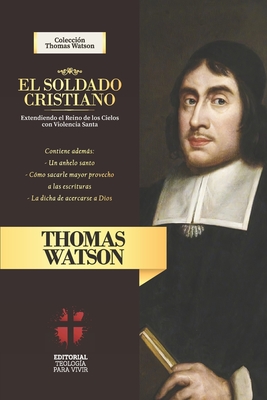
�C�MO PUEDO CRECER EN LA VIDA CRISTIANA? �DEBE EL CREYENTE INVOLUCRARSE EN LA GUERRA ESPIRITUAL?Watson describe c�mo el cristiano debe arrebatar el reino de los cielos con santa violencia a trav�s de la lectura y exposici�n de las Escrituras, la oraci�n, la meditaci�n, el autoexamen, la conversaci�n y el guardar el D�a del Se�or. Explica c�mo el creyente debe luchar contra s� mismo, contra Satan�s y contra el mundo, y refuta las objeciones e impedimentos para ofrecer tal violencia. La profunda espiritualidad de Watson, su estilo preciso y su belleza de expresi�n lo convierten en uno de los m�s admirables, citables y devocionales de todos los puritanos.Joel BeekeMuchos hoy en d�a creen que la vida cristiana es bastante f�cil de dirigir y de vivir. Pero los puritanos la ve�an como una guerra, como una lucha, como una "santa violencia" (usando los t�rminos de ellos). Y esta santa violencia debe ser presentada no solo contra uno mismo, sino tambi�n contra Satan�s, el mundo y tambi�n el cielo. Y en esta confrontaci�n, debemos usar las armas que Dios nos ha dado: la lectura de la Palabra, la exposici�n de la Palabra, la oraci�n, la meditaci�n, el autoexamen y la debida observancia del D�a del Se�or. Dejen que Thomas Watson sea su gu�a a trav�s del campo minado que se encuentra entre nosotros y el cielo.Don Kistler�Hay una magn�fica uni�n de sana doctrina, experiencia escudri�adora del coraz�n y sabidur�a pr�ctica en todos los escritos de Watson!Charles Spurgeon (1834-1892)THOMAS WATSON (1620-1686), es uno de los m�s conocidos puritanos ingleses, curso estudios en la Universidad de Cambridge donde destaco por su erudici�n y profunda piedad. Es autor de muchos libros entre los que se destacan Cuerpo de Divinidad, El Padre nuestro, y Los Diez Mandamientos.
BUY NOW
Paperback, 386 pages
Published November 13th 2020 by Teologia Para Vivir
Subscribe
Get Bible verse every day in your inbox
Read on Mobile


Group of Brands


© 2026 Bibleportal.com All rights reserved.
He was educated at Emmanuel College, Cambridge, where he was noted for remarkably intense study. In 1646 he commenced a sixteen year pastorate at St. Stephen's, Walbrook. He showed strong Presbyterian views during the civil war, with, however, an attachment to the king, and in 1651 he was imprisoned briefly with some other ministers for his share in Christopher Love's plot to recall Charles II of England.
He was released on 30 June 1652, and was formally reinstated as vicar of St. Stephen's Walbrook. He obtained great fame and popularity as a preacher until the Restoration, when he was ejected for nonconformity. Not withstanding the rigor of the acts against dissenters, Watson continued to exercise his ministry privately as he found opportunity. Upon the Declaration of Indulgence in 1672 he obtained a license to preach at the great hall in Crosby House. After preaching there for several years, his health gave way, and he retired to Barnston, Essex, where he died suddenly while praying in secret. He was buried on 28 July 1686.
Thomas Watson was an English, non-conformist, Puritan preacher and author.
He was educated at Emmanuel College, Cambridge, where he was noted for remarkably intense study. In 1646 he commenced a sixteen year pastorate at St. Stephen's, Walbrook. He showed strong Presbyterian views during the civil war, with, however, an attachment to the king, and in 1651 he was imprisoned briefly with some other ministers for his share in Christopher Love's plot to recall Charles II of England.
He was released on 30 June 1652, and was formally reinstated as vicar of St. Stephen's Walbrook. He obtained great fame and popularity as a preacher until the Restoration, when he was ejected for nonconformity. Not withstanding the rigor of the acts against dissenters, Watson continued to exercise his ministry privately as he found opportunity. Upon the Declaration of Indulgence in 1672 he obtained a license to preach at the great hall in Crosby House. After preaching there for several years, his health gave way, and he retired to Barnston, Essex, where he died suddenly while praying in secret. He was buried on 28 July 1686.
... Show more