
- Bible
- Read the Bible
- Bible Versions
- Verse of the Day
- Reading Plans
- Verses by Topic
- Books of the Bible
- Bible Images
- Study
- Commentaries
- Concordances
- Dictionaries
- Encyclopedias
- Sermons
- Bible Atlas & Maps
- BP Wiki
- Devotionals
- Today's Devotionals
- Light of the World
- All Devotionals
- Inspirational Quotes
- More
- Picture Quotes
- Videos
- Inspirational
- Bible Study
- What The Bible Says
- Bible Q&As
- Daily Bread
- Bible by Genre
- Bible Stories
- Random Bible Verse
- Community
- Store
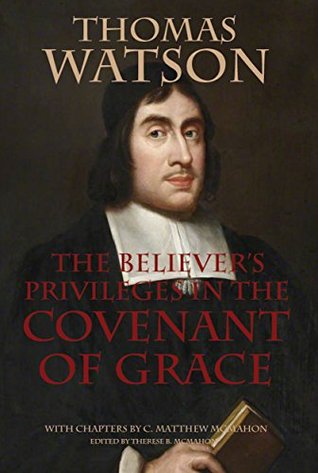
The Believer's Privileges in the Covenant of Grace
by Thomas Watson
Thomas Watson (1620-1686) was one of the most highly esteemed nonconformist Puritans of his day, as well as being an extremely popular preacher. Today's Reformed and Christian audience adores his simple style and biblical exposition which are filled with sound doctrine, practical wisdom, and heart-searching application.
In this work, Watson explains what the biblical privileges of the Covenant of Grace are for a believer. He demonstrates that such privileges are in fact benefits lavished on the Christian by the work and ministry of Jesus Christ, through his life, death, resurrection and present intercession.
It is impossible to divorce the privileges of a believer as a redeemed individual with the connection he has with Christ in the Covenant of Grace. Christ’s covenant, ministered to the believer through faith, is the mode in which the believer will obtain all the benefits offered. There are, according to Watson, twelve royal benefits of being in the covenant with Christ’s blood covering the believer. Such royal privileges surround death, the ministry of angels, the presence of Christ in glory, a blessed inheritance, clear knowledge, perfect love, the resurrection and glorification of our bodies, a holy disposition in heaven, a vindication of our reputations at the judgment, a complete sentence of absolution from sin, and a public and honorable mention of all the good which believers have done in this life.
After explaining his main text, “All things are yours,” (1 Corinthians 3:21), and expounding the twelve privileges, he spends the last third of the work showing important inferences which evolve out of this doctrine.
Finally, he completes the work with its longest chapter (chapter 22) showing all the duties that a believer should exercise knowing, now, that he has received such privileges from Christ in the Covenant of Grace.
Watson’s style and illustrative manner is second to none in Puritan literature. His illustrations are often short, pithy and to the point. They paint wonderful pictures to drive home the truth of the Scripture-filled work on this most important topic. It is truly a work that ought not to be skimmed, or read in a rush, but rather, soaked in and meditated upon to milk out of it all its benefits, that Christ may be clearly seen.
This work is not a scan or facsimile, has been carefully transcribed by hand being made easy to read in modern English, and has an active table of contents for electronic versions.
In this work, Watson explains what the biblical privileges of the Covenant of Grace are for a believer. He demonstrates that such privileges are in fact benefits lavished on the Christian by the work and ministry of Jesus Christ, through his life, death, resurrection and present intercession.
It is impossible to divorce the privileges of a believer as a redeemed individual with the connection he has with Christ in the Covenant of Grace. Christ’s covenant, ministered to the believer through faith, is the mode in which the believer will obtain all the benefits offered. There are, according to Watson, twelve royal benefits of being in the covenant with Christ’s blood covering the believer. Such royal privileges surround death, the ministry of angels, the presence of Christ in glory, a blessed inheritance, clear knowledge, perfect love, the resurrection and glorification of our bodies, a holy disposition in heaven, a vindication of our reputations at the judgment, a complete sentence of absolution from sin, and a public and honorable mention of all the good which believers have done in this life.
After explaining his main text, “All things are yours,” (1 Corinthians 3:21), and expounding the twelve privileges, he spends the last third of the work showing important inferences which evolve out of this doctrine.
Finally, he completes the work with its longest chapter (chapter 22) showing all the duties that a believer should exercise knowing, now, that he has received such privileges from Christ in the Covenant of Grace.
Watson’s style and illustrative manner is second to none in Puritan literature. His illustrations are often short, pithy and to the point. They paint wonderful pictures to drive home the truth of the Scripture-filled work on this most important topic. It is truly a work that ought not to be skimmed, or read in a rush, but rather, soaked in and meditated upon to milk out of it all its benefits, that Christ may be clearly seen.
This work is not a scan or facsimile, has been carefully transcribed by hand being made easy to read in modern English, and has an active table of contents for electronic versions.
BUY NOW
Kindle Edition
Published November 11th 2017 by Puritan Publications
Subscribe
Get Bible verse every day in your inbox
Read on Mobile


Group of Brands


© 2026 Bibleportal.com All rights reserved.
He was educated at Emmanuel College, Cambridge, where he was noted for remarkably intense study. In 1646 he commenced a sixteen year pastorate at St. Stephen's, Walbrook. He showed strong Presbyterian views during the civil war, with, however, an attachment to the king, and in 1651 he was imprisoned briefly with some other ministers for his share in Christopher Love's plot to recall Charles II of England.
He was released on 30 June 1652, and was formally reinstated as vicar of St. Stephen's Walbrook. He obtained great fame and popularity as a preacher until the Restoration, when he was ejected for nonconformity. Not withstanding the rigor of the acts against dissenters, Watson continued to exercise his ministry privately as he found opportunity. Upon the Declaration of Indulgence in 1672 he obtained a license to preach at the great hall in Crosby House. After preaching there for several years, his health gave way, and he retired to Barnston, Essex, where he died suddenly while praying in secret. He was buried on 28 July 1686.
Thomas Watson was an English, non-conformist, Puritan preacher and author.
He was educated at Emmanuel College, Cambridge, where he was noted for remarkably intense study. In 1646 he commenced a sixteen year pastorate at St. Stephen's, Walbrook. He showed strong Presbyterian views during the civil war, with, however, an attachment to the king, and in 1651 he was imprisoned briefly with some other ministers for his share in Christopher Love's plot to recall Charles II of England.
He was released on 30 June 1652, and was formally reinstated as vicar of St. Stephen's Walbrook. He obtained great fame and popularity as a preacher until the Restoration, when he was ejected for nonconformity. Not withstanding the rigor of the acts against dissenters, Watson continued to exercise his ministry privately as he found opportunity. Upon the Declaration of Indulgence in 1672 he obtained a license to preach at the great hall in Crosby House. After preaching there for several years, his health gave way, and he retired to Barnston, Essex, where he died suddenly while praying in secret. He was buried on 28 July 1686.
... Show more